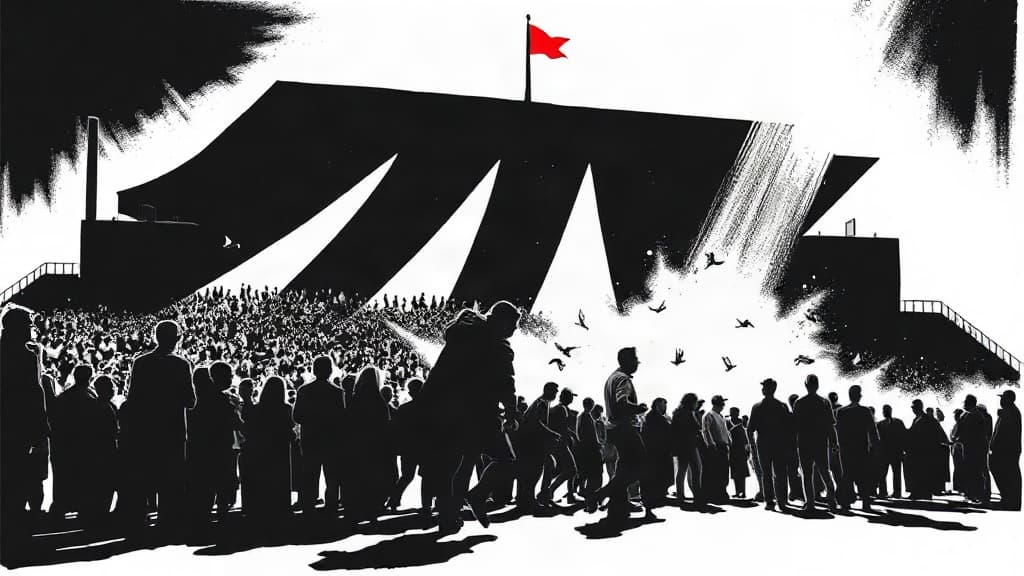
Thousands of Albanians flooded the streets of Tirana on Saturday demanding Prime Minister Edi Rama resign, clashing with police who answered them with tear gas and water cannons — the latest eruption in a months-long populist revolt against a corrupt political class that has left citizens as, in one protester's words, "citizens without a state."
The stakes are plain: when a government stops representing its people, the people eventually stop accepting the government. That truth doesn't stop at Albania's borders. The same uniparty rot Albanians are fighting — entrenched politicians who serve themselves, not the public — is the same disease in Washington, where both parties agree on spending your money and keeping their power.
Saturday's protest began peacefully but turned volatile when masked demonstrators smashed windows on government ministry buildings. Police deployed tear gas and water cannons against crowds throwing rocks and Molotov cocktails, according to the Los Angeles Times. Protesters used wooden sticks to destroy street cameras and government building windows. Clouds of tear gas spread across several streets in the capital.
Albanians traveled from across the country and abroad for the rally, timed to the 114th anniversary of Albania's independence — a day normally reserved for celebration, now marked by revolt. Police set up checkpoints on roads in and out of Tirana.
Arian Lleshi, 33, traveled from the United Kingdom specifically for the protest. "We have been suffering for far too long," he said. "We have spread ourselves across Europe and around the world, and it is almost as if we are citizens without a state. We are like stateless citizens." The political parties operating since communism fell in the 1990s "no longer represent anyone," Lleshi added. "They need to make way for a new generation of intellectuals and people who have a greater stake in the country's future."
The uprising began in late May as opposition to a major luxury tourism development on Albania's southern coast — a project linked to an investment firm founded by Jared Kushner, President Trump's son-in-law. Both outlets reported the Kushner connection; neither explored what it means that an American political dynasty's business dealings helped ignite a foreign revolt. The movement became known as the Flamingo movement, later joined by September's student demonstrations demanding better education and living standards. Many of those turned violent. Now the demands have broadened beyond any single issue to the entire system.
Student Juna Vasili was blunt: "We have come out to demand our rights. We have had enough. Life has become very difficult. We are calling for a change to the entire system." Retiree Suzana Gjeta said she lives on just 120 euros a month — about $131 — and was demonstrating for young people and for herself. "We hope this system will go, that Edi Rama will go, and that this corruption will end," she said.
SFGATE omitted the Molotov cocktails and the detail that the protest began peacefully before masked groups broke away — small framing choices that make the demonstrators look more uniformly violent. The Los Angeles Times included both, giving a fuller picture of a protest that started lawful and escalated.
Here is the open question: Albania's post-communist political class has had decades to deliver and has failed. The protesters say the parties represent no one. In Washington, the Republican and Democratic establishments have likewise spent decades consolidating power while working Americans get poorer. The Albanians are done waiting. How long before Americans reach the same breaking point?