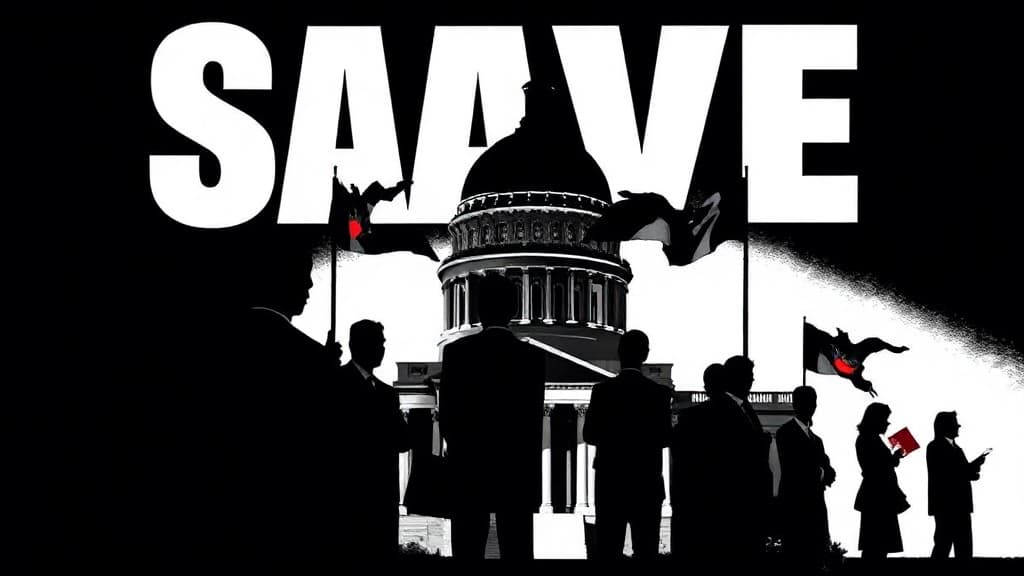
Congress bolted for a two-week July 4 recess Tuesday after 14 Republicans killed the procedural vote that could have forced the Senate's hand on the only serious election integrity bill in Washington — leaving proof-of-citizenship voting requirements dead in the water while lawmakers barbecue back home.
The stakes are straightforward: the SAVE America Act would require documentary proof of U.S. citizenship to register to vote in federal elections. The House has passed it three times. The Senate has refused to act each time. This was the last real leverage point before the August recess, and it's gone.
At issue was how to attach the SAVE Act to the $1.15 trillion National Defense Authorization Act. Speaker Mike Johnson wanted to use a procedural maneuver called "MIRVing" — passing the NDAA and the SAVE Act separately, then merging them into one bill before sending the package to the Senate. Rep. Anna Paulina Luna called it what it was: a "procedural head fake." She argued that approach would let the Senate strip the election provisions during conference negotiations. Instead, she wanted the SAVE language amended directly into the NDAA text, which would force the Senate to either pass the defense bill with it or kill the whole thing.
"The current plan being proposed by HOUSE GOP to 'MIRV' NDAA + SAVE AMERICA is a procedural head fake," Luna wrote on X. "This does not do anything but guarantee the Senate will EASILY TAKE OUT SAVE America from the NDAA."
She's not wrong about the Senate's intentions. Senate Majority Leader John Thune has already filed cloture on his chamber's own version of the NDAA — without the SAVE Act attached. The top Democrat on the House Rules Committee, Rep. Jim McGovern, flatly declared on the floor: "The Senate will not pass an NDAA with the SAVE Act included. They have already said that."
Fourteen Republicans voted against the rule Tuesday, sinking it 198-224. Luna and others like Rep. Chip Roy — who cited the House's failure to act on border security amendments — held the line. House Majority Leader Steve Scalise cast a "no" vote as a procedural move to preserve the option to bring it back later, a standard leadership loophole.
Johnson framed the holdouts as voting against the SAVE Act itself. "They also, as you know, as a consequence, voted against the SAVE America Act," he told reporters. That's spin. They voted against a process they believe lets the Senate off the hook.
Democrats, predictably, framed the entire fight as voter suppression. House Minority Whip Katherine Clark called it "taking away your right to vote." The Washington Examiner highlighted that framing; Breaking Defense leaned into calling the SAVE Act a "voter restriction bill." Neither outlet grappled with the basic question: why should non-citizens be on federal voter rolls at all?
Trump met with Johnson last Thursday and posted on Truth Social calling for Republican unity. The Senate went into recess early the same day after Trump pressured them at a heated lunch. No senator objected to the adjournment.
The House returns July 13 with just eight legislative days before a monthlong August recess. Senate rules require 60 votes to overcome a filibuster. Thune says he doesn't have them. Nobody seems interested in finding out what happens if the Senate is actually forced to vote on the record.
The uniparty recesses together. Your vote stays unprotected.