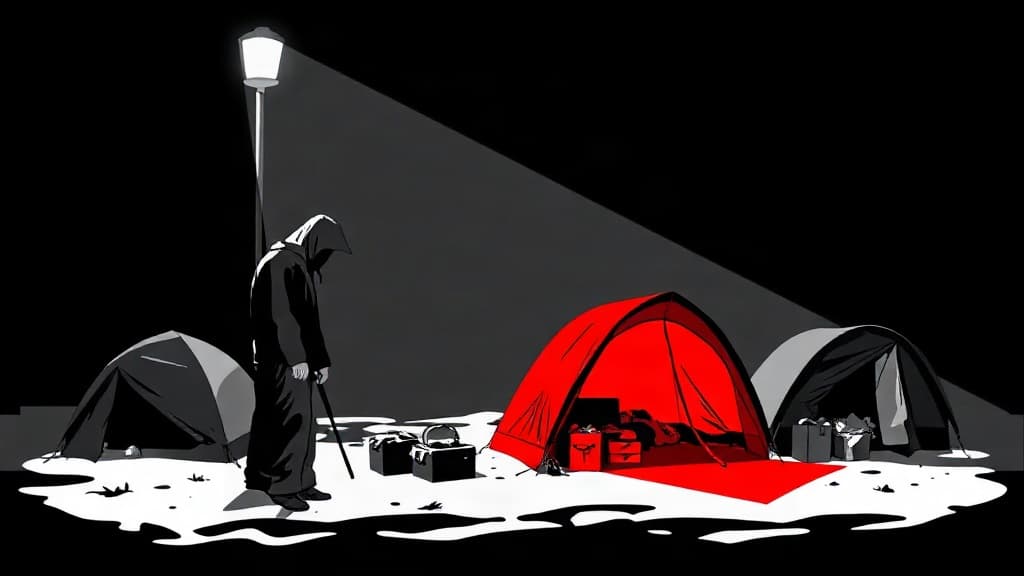
Americans slept on concrete sidewalks before dawn on Black Friday just to afford Christmas gifts — and the retail industry wants you to call that economic strength.
The National Retail Federation projects holiday sales will hit $1.01 trillion this year, up 4.2% from last year. Cue the celebration from the financial press. But here's what the NRF buries in its own projection: higher prices account for part of that increase. People are spending more because things cost more, not because they have more to spend. That's not a boom. That's an inflation tax dressed up as a headline.
The New York Post covered shoppers camping outside Target, Walmart, and Best Buy across California in the pre-dawn chill. Fox Business reported lines forming at Walmart locations as early as 3 a.m. Walmart Chief Merchandising Officer Julie Barber told Fox Business that customers are being "intentional" about their shopping and said she was "pretty excited about the resiliency of our customer right now." Read that again. Seven in 10 shoppers told Walmart's own 2026 Holiday Trend Report that lower prices would make holiday shopping easier. That's not resiliency. That's a cry for relief.
Fox Business played up the AI angle — shoppers using Walmart's assistant, Sparky, to compare prices — as though strategizing your Christmas list with a chatbot is innovation rather than a sign that buying gifts now requires military-grade planning. Caden Slesser, shopping in Pennsylvania, cut through the corporate spin plainly: "Everything's more expensive now, so you got to be cautious of what you spend." Jen Harsh, a mother of five making rounds at Walmart, Target, and Just Press Play, said the tradition has fundamentally changed since COVID. The deals themselves tell the story — AirPods marked down from $249 to $149, a Nintendo Switch bundle dropped from $549.99 to $499. These aren't luxury splurges. These are the items families need price cuts on just to put something under the tree.
The press frames this as a spending surge. The NRF frames it as growth. Walmart frames it as resiliency. Working Americans sleeping on sidewalks at 3 a.m. to save a hundred bucks on headphones know exactly what it is: survival in an economy that has shredded their purchasing power and left them scrambling for discounts just to keep pace.
When families have to treat Christmas shopping like a financial combat operation, the problem isn't that they aren't spending enough. The problem is that everything costs too much — and nobody in power wants to admit why.