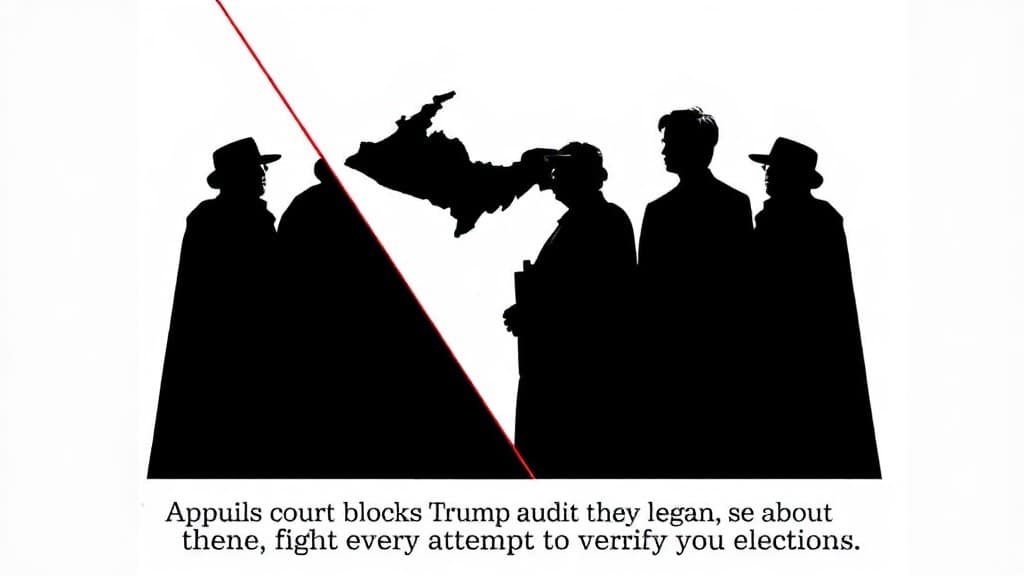
Another federal court just told the American people they can't verify their own elections. On Wednesday, a three-judge panel of the 6th Circuit Court of Appeals ruled 2-1 that Michigan does not have to turn over its unredacted voter rolls to the Justice Department — the first appeals court to weigh in on the administration's effort to audit voter registration data from states across the country.
Here's what that means: the federal government asked to see who's on the rolls. Michigan Secretary of State Jocelyn Benson — who is currently running for the Democratic nomination for governor — said no. And two federal judges agreed that a 1960 civil rights law designed to protect voting rights somehow prevents the government from checking whether those rights are being exercised by eligible people.
Judge Andre Mathis, writing for the majority alongside Judge Guy Cole Jr., said the Civil Rights Act of 1960 gave the government power "to ensure that everyone who had the right to vote could freely exercise that right. But today, the government invokes Title III for an inverse purpose — to ensure that some people have not voted." Judge John Nalbandian dissented.
The court's reasoning turned on a technicality: Michigan's qualified voter file was created by state officials, not received from a third party, so it doesn't qualify as records that "come into the possession" of election officials under the 1960 law. Benson did hand over the public voter list — but refused the version containing driver's license numbers, partial Social Security numbers, and birth dates that would allow cross-referencing against federal databases.
This isn't just about Michigan. The Justice Department has sued 30 states that refused to produce unredacted voter rolls, and nine district courts have ruled against the administration. The Detroit Free Press characterized Trump's claims of voter fraud as pressed "without evidence." CNN framed the effort as part of the administration's attempt to "assert more federal control in elections." CBS emphasized the "sensitive" nature of the data.
What none of those outlets grapple with: if the rolls are clean, verification proves it. If they're not, Americans deserve to know. Instead, every attempt to check is treated as an assault on democracy itself.
CNN reported that the DOJ planned to compare state rolls against a Department of Homeland Security citizenship verification system — a tool already available to election officials voluntarily, but one that has "developed a reputation for turning up false positives because the data can be outdated, with naturalized citizens" at particular risk. That's a legitimate concern. It's also a solvable one — if anyone actually wanted to solve it.
The district court judge who first dismissed this case, Hala Jarbou, was a Trump appointee from his first term. She warned that interpreting the National Voter Registration Act to require disclosure of private information "would potentially cause the statute to impose an unconstitutional burden on the right to vote guaranteed by the First Amendment." So even a judge the president put on the bench wouldn't go along.
Meanwhile, Benson racks up legal victories while campaigning for governor on her record of fighting federal audit requests. The political incentives are not subtle.
The 6th Circuit split opens a path to the Supreme Court. And the fundamental tension remains: the same officials who insist our elections are the most secure in history are the ones fighting hardest to prevent anyone from checking.