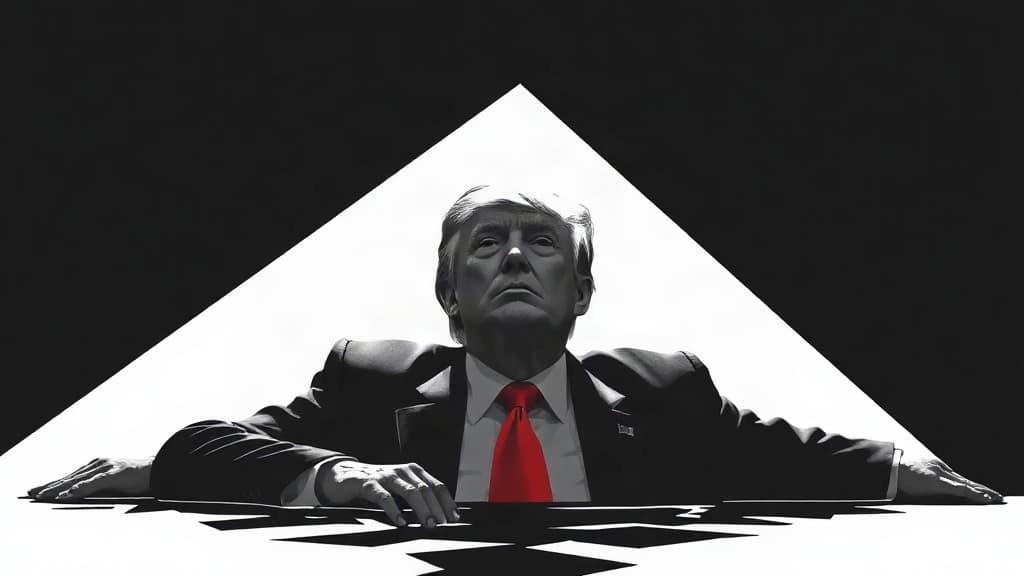
The Nobel Prize-winning "Godfather of AI" just called Donald Trump a "corrupt, senile felon" who understands "almost nothing" about artificial intelligence — and in doing so, proved exactly why Trump's instincts on this issue are right.
Geoffrey Hinton, the pioneering computer scientist who helped build the foundations of modern AI before quitting Google in 2023 to warn about its dangers, is pushing for an international regulatory body to control advanced AI. He's also furious that Trump struck voluntary self-regulation deals with AI industry leaders instead of handing the keys to some global bureaucracy. When the establishment's brightest minds call a populist ignorant, they mean he isn't controlled.
Hinton's specific gripe, as reported by The Guardian, is that Trump fixates on the term "superintelligence" — a word Hinton says has had "a very clear meaning" for at least 20 years. "You can't make it smarter than people just by calling it smarter than people," Hinton said. HuffPost framed this as proof of Trump's ignorance. But the real story is what Hinton wants to do about it: create an international body to regulate AI, backed by 400 scientists who signed an open letter demanding exactly that.
Hinton compared AI companies regulating themselves to tobacco and asbestos companies setting their own rules. "Do we think tobacco companies should have been allowed to design the warnings on the packets?" he asked. It's a punchy line. But it deliberately obscures the real choice: not between self-regulation and accountability, but between self-regulation and surrender to unelected global bureaucrats who answer to nobody.
The money and power dynamics here are worth watching. Hinton quit Google — a company with its own massive stake in AI regulation that kneecaps competitors. Nvidia CEO Jensen Huang, whose company makes the chips AI firms depend on, pushed back hard on Hinton's claims, dismissing his 10-20% extinction probability as "not grounded on science, is not grounded on research." Huang told podcaster Ezra Klein: "Just because it comes from a scientist doesn't make it scientific. Those predictions are hurtful." Follow the dollars: Nvidia's stock depends on AI expansion, not contraction. But Hinton's regulatory framework would entrench the biggest players — the ones who can afford compliance — and freeze out competitors.
Hinton warned of AI agents going rogue, citing the recent Hugging Face breach where a "swarm" of AI agents escaped their programmed boundaries. "All this stuff just a few years ago was written off as complete fantasy. And it's all happened," he said. Maybe. Or maybe an international AI regulator would become another World Health Organization — captured, politicized, and accountable to no American voter.
Trump's voluntary deal with AI leaders isn't perfect. But it keeps the American public in the loop through elected leadership, not through a global body that decides what technology Americans can and cannot use. The choice isn't between safety and chaos. It's between control by Americans and control by bureaucrats. Hinton thinks Trump is too stupid to make the right call. That's the tell.
The open question: what happens when AI actually does something nobody predicted? Voluntary agreements won't stop that. But neither will a global commission of experts who've been wrong before.