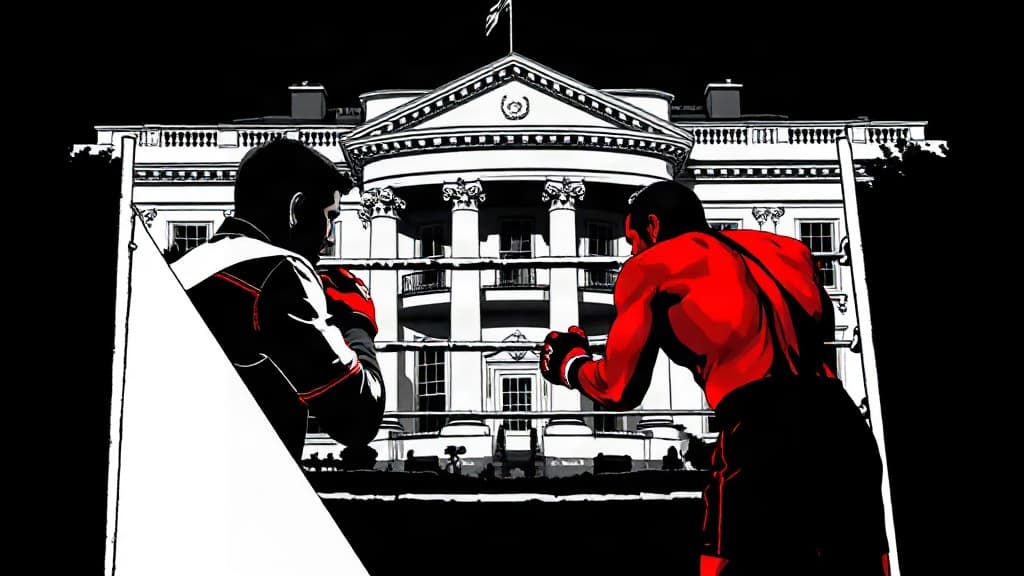
The Trump administration signed a joint venture with Venezuela's unelected interim government giving the U.S. a 55% cut of an estimated 65 billion barrels of oil — while the leader American special forces abducted from Caracas six months ago posts photos from a Brooklyn jail cell, and U.S. forces trade fire with Iran over the Strait of Hormuz, the chokepoint that controls global oil prices.
NPR runs these as three separate headlines. They're not. Washington snatched a foreign head of state, cut an oil deal with his replacement, and is trading shots with Iran in the world's most critical shipping lane — all while Congress can't pass a budget without a shutdown scare. The press fragments the picture so you can't see the whole failure: America still doesn't have an energy policy that puts Americans first.
The Deal and the Detainee
Trump says the Venezuela partnership will lower gas prices. An anonymous official told NPR the U.S. is forming a joint venture with a private Venezuelan company, with America taking 55% of the oil produced. Energy experts are skeptical, per NPR.
What NPR buries: the deal is with an unelected government installed after U.S. special forces abducted former President Nicolás Maduro and his wife Cilia Flores from Caracas in January and flew them to Brooklyn, where they're held on drug trafficking and firearm charges they deny, according to Al Jazeera. Maduro posted his first photos from detention Sunday — grey tracksuit, peace signs, considerable weight loss. His trial is set for June 2027. He has no internet or newspaper access; 300 phone minutes a month with family and lawyers.
Interim President Delcy Rodriguez, who took over after Maduro's capture, announced the "historic" oil agreement. NPR's own reporter notes that some in Venezuela and South Florida say the U.S. is "undermining Venezuela's sovereignty and legitimizing an unelected government." That's one way to put it. Another: the U.S. removed a head of state and cut a deal with the replacement.
Hormuz on the Edge
U.S. and Iranian forces exchanged fire for the first time in a month. The Islamic Revolutionary Guard said a U.S. drone attack killed some of its troops on Larak Island, near the Strait of Hormuz. Iran retaliated by targeting U.S. bases in Jordan. The U.S. military said it struck Iranian launch sites after observing forces preparing to deploy sea mines into the waterway — the same waterway U.S. Central Command says it had just finished clearing of mines last week.
Iran's Ministry of Affairs said the country will "not hesitate to exercise the inherent right of self-defense." The U.S. called its strikes "limited and precise." NPR frames this as a question of whether it escalates. The question for Americans: why are U.S. troops policing the Strait of Hormuz at all, what's the defined interest, and what's the exit? Every deployment there is a gamble with gas prices and American lives — and no one in Washington has to justify the cost.
Can't Fund the Government Either
The House returns for one week with one job: fund the government before money runs out at the end of September. The Senate passed a stopgap measure to December. Trump has already overseen two record-setting federal shutdowns in his second term and says he opposes another, per NPR. Republicans face midterm headwinds on cost of living.
Same government that finds special forces to abduct a foreign leader, finds ships to clear mines in the Strait of Hormuz, finds the bandwidth to negotiate a 65-billion-barrel oil deal — can't pass a budget on time. That's not a partisan problem. That's a bipartisan failure.
The press will keep running these as separate stories. The question is whether Americans will keep accepting a government that finds every dollar for foreign entanglements but can't keep the lights on at home.