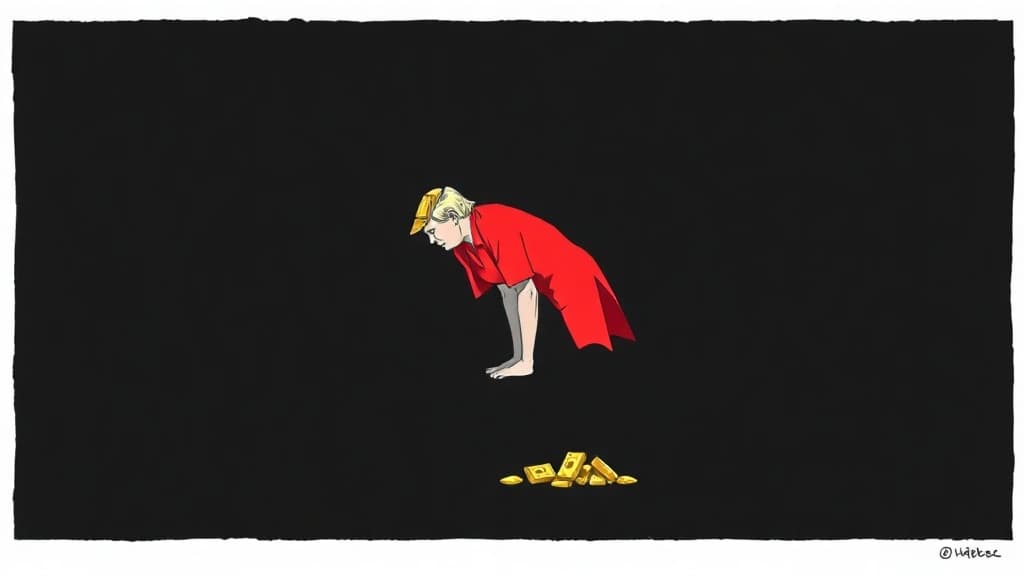
A mining executive handed President Trump a solid-gold replica at a State Department roundtable, and the press spent its column inches on Trump's reaction—because covering the lobbying pitch underneath would mean covering who's buying access and what they're selling.
Tom Albanese, chairman of American Ocean Minerals, presented the gift at a critical minerals roundtable. "I have to present to you a gift to the American people on a project that I've been very involved with," Albanese said. "I'm like you. I'm a fan of gold, and this is a solid-gold replica of a deep-sea nodule."
Trump lit up: "Where's it go? Come on, bring it over here." Albanese told panelists to "pass it down." Trump pressed: "I want the gold. Lemme see what it looks like. It should be very heavy." Once he held it, he said, "That's fantastic."
Atlanta Black Star framed the exchange as Trump behaving "like a child in front of birthday cake" and ran social media mockery calling it "tacky" and "technically a bribe." The outlet barely touched what Albanese was actually doing there: pitching deep-sea mining to the president of the United States. The actual nodules sitting thousands of feet underwater contain no gold at all, according to the International Seabed Authority—they're packed with manganese, nickel, cobalt, and copper. Albanese wasn't giving a geology lesson. He was wrapping a mining play in something shiny, and the press let him get away with it.
This isn't new. Apple CEO Tim Cook showed up at the White House in August 2025 with an engraved piece of Apple glass mounted on a 24-karat gold base, calling it "a unique unit of one." The very next day, Trump's tariffs hit more than 90 countries—and Apple walked away with exemptions covering chips, according to Atlanta Black Star. Follow the money: gift, meeting, policy win. The press covered the prop. The executives got the access.
And when the machinery turns on regular people, nobody's watching.
Case in point: Polymarket, the prediction platform valued in the billions, is being sued by a bettor who says he correctly predicted Trump would say "Khamenei" during a week in March—and got stiffed out of $170,000.
Jesús Manuel Gonzalez Hernandez bought 170,000 "yes" shares for $300 on a market asking whether Trump would say "Khamenei" or "Ayatollah" during the week of March 15. The bet came weeks after the war with Iran began on Feb. 28.
White House transcripts and video show Trump said "Khamenei" twice aboard Air Force One that week: "They showed about 250,000 people in the square, saying how much they love Khamenei."
Polymarket resolved the market "no." Their argument: Trump mispronounced the name and was referring to Ruhollah Khomeini—Iran's leader who died in 1989.
Gonzalez Hernandez's lawyers called that implausible. "Khomeini had been dead for nearly 37 years," the suit states. "The President was talking about a live war with a living adversary. To hear a reference to a man dead since 1989, one has to be looking for a reason not to pay." The lawyers allege Polymarket's judgment stemmed from either failed technology or an operator override.
Attorney Max Burwick told the New York Post: "Our client's case is about being treated unfairly by a multi-billion dollar company. He trusted Polymarket, played by its written rules, and was wronged." Polymarket declined to comment. CEO Shayne Coplan and CMO Matthew Modabber, also named in the suit, could not be reached.
The press covers the man reaching for the gold rock. The mining executive gets his meeting. The platform keeps the money. The bettor gets nothing. Same story, different players.