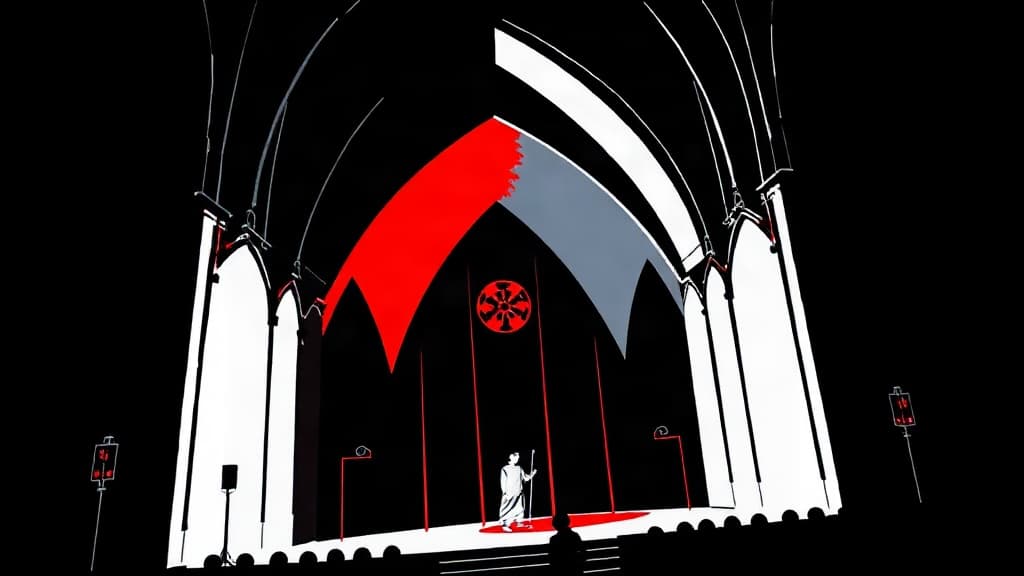
The Spokane Symphony is performing Handel's "Messiah" inside the Cathedral of St. John the Evangelist this week — putting a 285-year-old Christian masterpiece back in sacred space where it belongs, while the cultural establishment works overtime to scrub exactly this kind of tradition from American public life.
The three-day cathedral residency runs Thursday through Saturday, followed by a Nov. 22 performance at Sandpoint's Panida Theater — the symphony's first time bringing the piece to that venue. For Americans tired of watching the same institutions that once sustained Western civilization now treat Christianity as a problem to be managed, the programming decision speaks for itself.
Composed in 1741 by George Frideric Handel, "Messiah" traces the full arc of Jesus Christ's life — birth, crucifixion, resurrection — in three parts. Conductor James Lowe told the Spokane Spokesman-Review the Christmas association is almost accidental: "I always think it's kind of strange, in a way, because it's about the whole life of Christ so the Christmas part is only a small part."
Lowe is leading a smaller ensemble than most orchestras deploy for the piece, going for what he calls a "slightly more athletic and live way of performing this work." The four vocal soloists — soprano Chloe Sundet, alto Nicole Sonbert, tenor Namarea Randolph-Yosea, and bass Andrew Krikawa — are drawn from what Lowe described as "the auditioned group within the auditioned group." He called them the "special forces choir." "I really don't take any prisoners with some of the speeds I conduct these things at," Lowe said, "because there are some choruses that really have to sound like a revolution."
Revolution is the right word. Performing "Messiah" in a cathedral — "the perfect venue for this music," per Lowe — is a quiet act of cultural defiance in an era when the mere mention of Christ in a public square invites litigation.
Across the Northwest, communities are finding different ways to hold together. In Bend, Oregon, students at Silver Rail Elementary returned to class Thursday for the first time since a shooting left three students and a teacher dead, WEAU reported. Parents abandoned the drop-off line and walked their kids in. "Everybody walked their kids. Everybody talked to one another. The sense of community was really nice," parent Justinna Rosett said. The district installed a retired school resource officer full-time and brought in counselors. Over 90% of students returned. The rest transferred or withdrew to homeschool.
Two communities, two gatherings. One fills a cathedral with a declaration that Christ's story endures. The other walks children past doors that had to be replaced and windows that needed privacy screens. Both are acts of resilience. One is rooted in something that has outlasted every empire that tried to silence it.
The question isn't whether "Messiah" will survive the cultural revolution. It has survived worse. The question is whether the institutions now running American public life will notice what fills those cathedral aisles — and why.