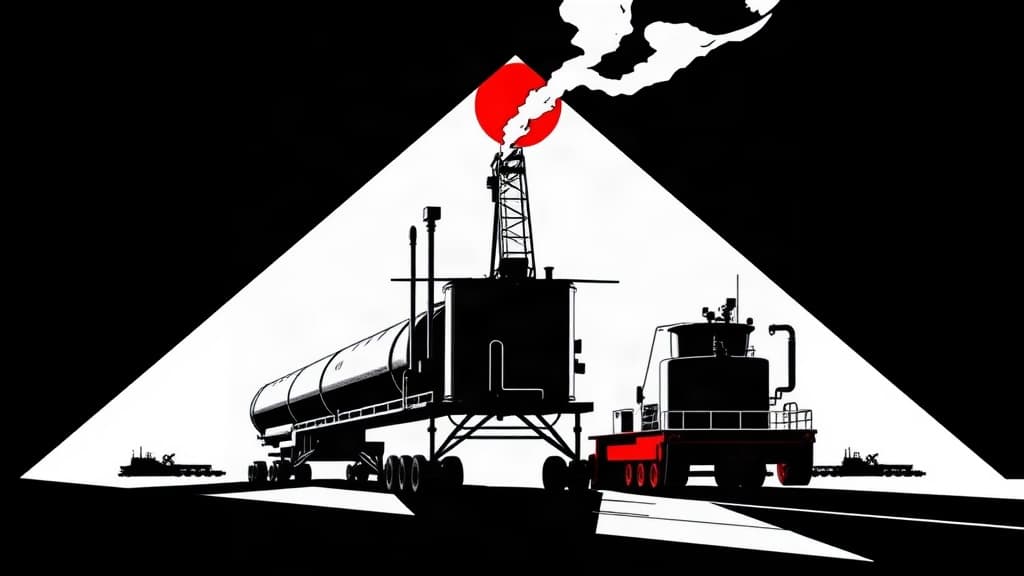
President Trump stood in a Corpus Christi warehouse Tuesday, pointed at a tanker visible through the open doors, and told the crowd it carried one million barrels of Venezuelan crude heading for Texas refineries — at zero cost to the American taxpayer. The question for working Americans paying record pump prices: will it actually lower their bills, or is this window dressing for a midterm campaign?
The stakes are real. Gas prices surged nationwide after Iran closed the Strait of Hormuz — a passageway for 20% of the world's oil — following the administration's decision to enter the war in February. Every climate policy, every foreign entanglement, every regulatory crackdown on domestic drilling is a bill somebody has to pay. Right now, that somebody is the American driver.
Trump touted the Venezuela deal as the fix. "The oil provided is being provided to the United States at zero cost to the American taxpayer," he said at the rally. A White House official told the New York Post the shipment is "the first of the billions of barrels to come from this deal." The August agreement with Venezuela's interim president Delcy Rodriguez gives the U.S. access to 65 billion barrels through a partnership with private business — more than doubling American oil reserves, according to Trump's own claims.
Venezuela holds roughly 303 billion barrels of crude, about 17% of the world's supply. The deal followed the January capture and extradition of Nicolás Maduro, who now faces narco-terrorism charges in New York. Secretary of State Marco Rubio — who also serves as national security adviser and was described by the Post as "a major force behind the US invasion of Venezuela and the subsequent oil deal" — joined Trump on stage briefly.
Here is where the press splits. The Guardian framed the entire event around Trump's joke that Venezuela could become "the 51st state," lumping it with Greenland, Canada, and Mexico as territories Trump has spoken of acquiring. The 51st-state line was a rally quip — but the Guardian led with it and buried the oil deal's substance. PBS barely mentioned the oil at all, instead focusing on the novelty of Rubio traveling with Trump and whether his presence blurred lines between governing and campaigning. The New York Post gave the most straightforward account of the deal's terms and the shipment's arrival.
What none of the outlets pressed hard enough: the irony that the administration needs Venezuelan oil precisely because it opted into a war that choked off the world's supply. The gas price crisis Trump now promises to solve is a crisis his own foreign policy helped create. And while a million barrels sounds impressive, it is a fraction of what the U.S. consumes daily — roughly 20 million barrels per day.
Critics, according to the Guardian, complain the administration hasn't pushed for democratic elections in Venezuela since Maduro's removal. That criticism is fair — but it also reveals the establishment's priorities: democracy promotion abroad matters more to them than affordable fuel at home.
Trump promised that "gasoline and diesel prices will soon come down." Americans have heard that before. The Venezuelan deal may deliver. But the deeper problem remains — this country has Alaska, it has the Gulf, it has shale, and every time someone proposes developing them, the same establishment that cheers foreign interventions screams about the environment. They mocked the Alaska push too.
The tanker is real. The oil is real. Whether the relief is real — and whether it lasts past Election Day — is the open question.