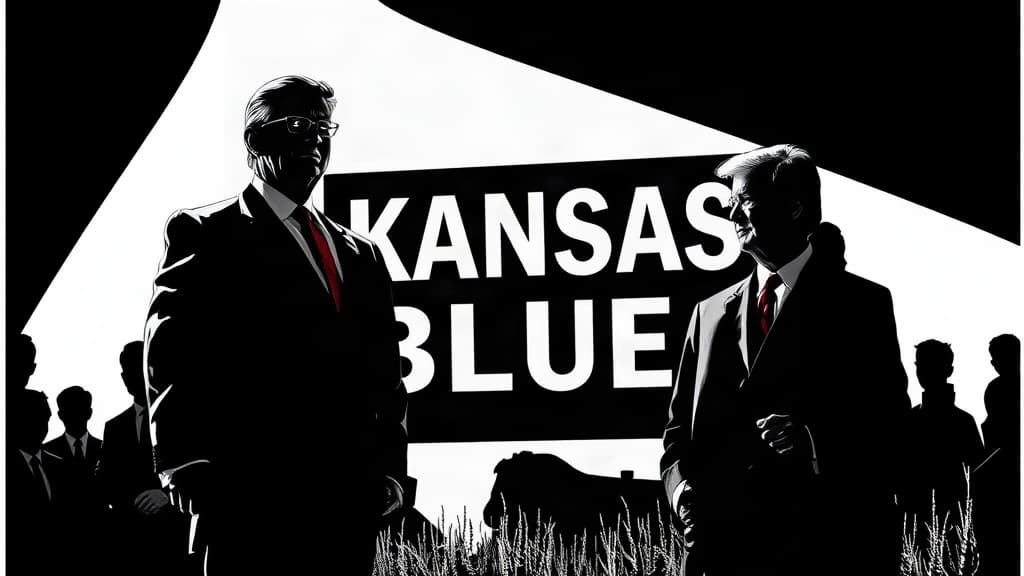
Democrat Cindy Holscher will be Kansas' next governor, defeating Republican Ty Masterson in a race the GOP had every structural reason to win — and fumbled anyway, handing another red state to the progressive agenda.
Why it matters: Republicans outspent Democrats more than 3-to-1, held a 60-year historical pattern favoring a party flip, and ran in a state with a heavily GOP legislature. They still lost. The defeat follows Democrat Adam Hamilton winning Kansas' U.S. Senate seat for the first time since 1932, and Democrat Chris Mann unseating Attorney General Kris Kobach. The pattern is unmistakable: the Republican establishment keeps writing checks it can't cash at the ballot box.
The Associated Press didn't call the governor's race until Thursday, after days of counting provisional ballots and local recounts in the narrowly contested election, according to NPR.
Masterson, president of the GOP-controlled state Senate, carried Trump's endorsement and promised property tax cuts. He vowed to be the "most pro-ag, pro-business, pro-oil and gas governor" the state has seen. It wasn't enough. Holscher tied him to the Sam Brownback tax-cut experiment that cratered state budgets and was later repealed. She ran on fighting "sweetheart deals" for billionaires and hammered Masterson on his record.
"He likes to throw around a whole lot of labels," Holscher said of Masterson calling her "the most radical, liberal, socialist Democrat ever." "You know why? Because that's all he's got."
The Republican Governors Association dumped $19 million into television and digital advertising attacking Holscher as an extreme liberal, according to ad-tracking firm AdImpact. Both candidates' fall fundraising was comparable. The spending gap made no difference.
Holscher built her campaign around a state moratorium on new AI data centers, arguing residents want limits on the energy and water drain and want guarantees of local hiring. "It cuts across party lines," she told reporters in Topeka. "The people are asking for reasonable things." She also opposed school vouchers, backed public school funding, and called for legalizing cannabis to generate state revenue.
The New York Post framed the result as part of a "massive wave of Democratic victories" giving Democrats a majority of governorships for the first time in two decades. NPR noted that of 36 gubernatorial races nationwide, Kansas was rated the most likely to flip from Democratic to Republican control — and it didn't.
Holscher also overcame resistance from her own party's outgoing governor. Laura Kelly initially backed another Democratic state senator, suggesting Holscher could be too liberal to win in November. Kelly eventually endorsed her — but not before recording a spot for Iowa's new governor-elect, Rob Sand.
The question now is whether Kansas Republicans will learn anything from losing a race they had no business losing, or whether the establishment will keep pouring millions into the same playbook and expecting a different result.