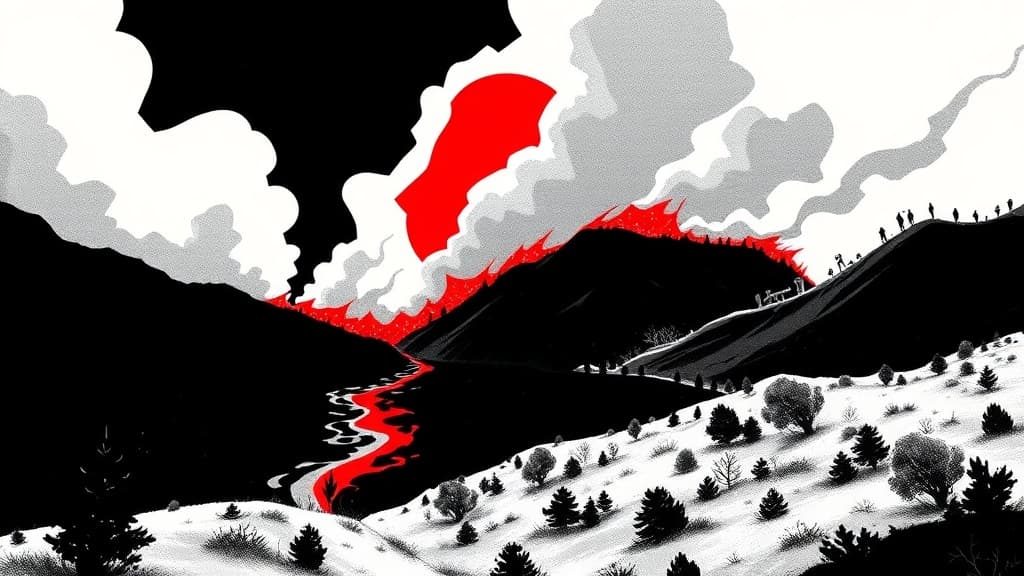
The largest wildfire in the United States is racing across southern Utah, grounding aircraft and forcing families from their homes, while the federal apparatus that controls vast swaths of Western land offers little but Facebook statements and forecasts of more extreme behavior to come.
The Cottonwood Fire ballooned to more than 144 square miles over the weekend, severely damaging the Eagle Point ski resort in Beaver County and forcing evacuations across multiple communities. In Marysvale, smoke blocked out the sun as ash rained down. Air tankers and helicopters were grounded Friday when gusts hit 45 miles per hour and humidity dropped into the single digits, leaving crews with essentially no aerial support. "We are seeing extreme fire behavior out there with some crown runs and definitely some spotting," said Alyssa Mason, a spokesperson assigned to the fire.
Utah Governor Spencer Cox declared an emergency and restricted fireworks—a move that acknowledges the danger but does nothing to address the underlying federal land management failures that have turned Western forests into kindling. The U.S. Forest Service, which oversees millions of acres in Utah, posted on Facebook that weather conditions would "slightly improve" but warned of more extreme behavior in the afternoon. That is the extent of the federal response on the record.
PBS framed the story around warm winter temperatures, noting Salt Lake City recorded its warmest winter on record at 40.7 degrees Fahrenheit—nearly 8 degrees above normal. AP led with the governor's emergency declaration and fireworks restrictions. Neither outlet pressed on why federal land managers have allowed fuel loads to build to dangerous levels, or why resources that could support fire suppression are instead diverted to climate initiatives and overseas commitments.
Utah state forester Jamie Barnes acknowledged this week that fires are spreading farther and faster "under conditions that defy historical expectations." Meteorologist Jason Straub told a community meeting in Beaver County: "We're looking at a full 48 hours of critical weather that we have not seen in Utah in the last five years."
Two other fires—the Iron and Cherry—merged overnight southwest of Salt Lake City, forcing evacuations in Eureka and the Vernon Reservoir area. That combined blaze covers roughly 91 square miles and is only 38 percent contained. Red flag warnings now stretch from Idaho to southern Arizona and New Mexico.
Nationally, nearly 3 million acres have burned since January, pushing the U.S. ahead of the 10-year average. At Grand Canyon National Park, officials are bracing for power outages as utilities initiate safety shutoffs—a last resort that has become routine across the West.
No injuries or deaths have been reported, according to response team spokesperson Jaclynn Swope. That is the one piece of good news in a landscape where communities are left to wonder what their federal government is actually prioritizing.