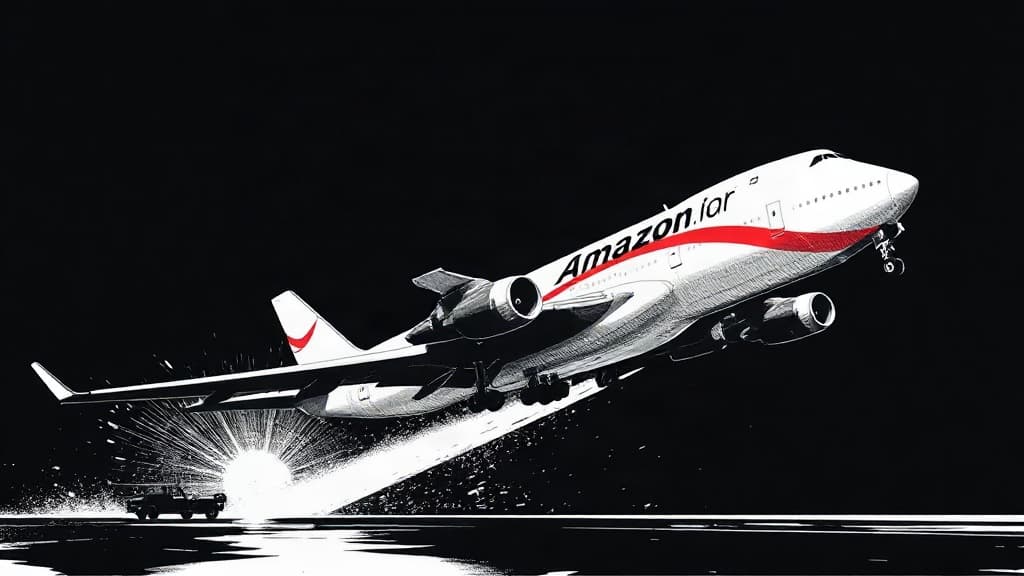
An Amazon cargo jet's critical braking systems never activated as it careened off a Miami runway Sunday, killing five working-class Americans in a cleaning crew van and injuring five others — and both the airline and the airport appear to have been running on systems that were already flagged as inadequate.
NTSB investigator Chihoon Shin confirmed Tuesday that while the aircraft's wheel brakes were applied, flight data shows no indication that speed brakes or thrust reversers were deployed during the landing attempt. Those systems are essential to slow a landing jet. Without them, a Boeing 767-300 becomes a 32,000-pound missile at runway's end.
The five dead — Rolando Aleman Leon, 55; Yoel Rodriguez Naranjo, 53; Julio C. Pineda, 75; Carlos Acosta Fajardo, 53; and Javierkys Reyes Quevedo, 47 — were all inside a van owned by Professional Ocean Service Corp., a contract cleaning company. A family member told NBC News that Leon and his coworkers were at the end of their shift when the jet hit them. The van was, in NTSB Chair Jennifer Homendy's words, "torn apart." Two of the injured remain in critical condition.
The pilots — Joseph Carroll, 55, and Jaime Felipe Silva Molina, 37 — were treated and released. They walked away. The people cleaning the planes did not.
This was the aircraft's third leg of the day: Cincinnati to Miami, Miami to San Juan, San Juan to Miami. Whether scheduling pressure played a role is unknown, but the plane was being worked hard on a Sunday.
AP News reported that strong winds over 25 knots were recorded and that experts who viewed landing footage say the plane appeared to hover without flaring the nose to force the wheels down, with a tail wind pushing it past its intended touchdown point. It barreled roughly 1,300 feet past the runway end. Why the pilot didn't abort and go around remains an open question.
Then there's the infrastructure failure. Miami International Airport does not have an Engineered Material Arresting System — the lightweight, crushable material installed at 120 U.S. airports that the FAA says has saved roughly 500 lives. AP noted this will likely be a focus of the investigation. Homendy has recommended these systems before. "Our recommendations must be implemented or we're going to be here again," she said Monday. Miami is technically compliant because it has a 1,000-foot safety buffer — a buffer this plane blew right through.
So a government agency makes recommendations, airports ignore them, and people die. That's the loop.
Amazon, for its part, issued the standard corporate condolences and noted the flight was operated by contractor 21 Air. Bezos's logistics empire contracts out the flying — and with it, the liability. 21 Air CEO Keith Winters said the company is cooperating with investigators.
The NTSB has recovered the flight data recorder and cockpit voice recorder. Interviews with the crew and air traffic controllers are pending. Shin said investigators need to "talk to the crew and get their account" before drawing conclusions about the braking failure.
The corporate press covered the victims' names and the grief. NBC and CBS led with identifications and mourning statements. Only the New York Post led with the braking failure — the mechanical fact that explains why five people are dead. AP alone flagged the missing runway safety system and the wind conditions. Nobody pressed Amazon on its contractor model or its grueling same-day cargo schedule.
Five Americans who clean planes for a living are dead because systems that should have stopped a runaway jet didn't work — and systems that could have caught it at the runway's end were never installed. The investigation will take months. The recommendations will gather dust.