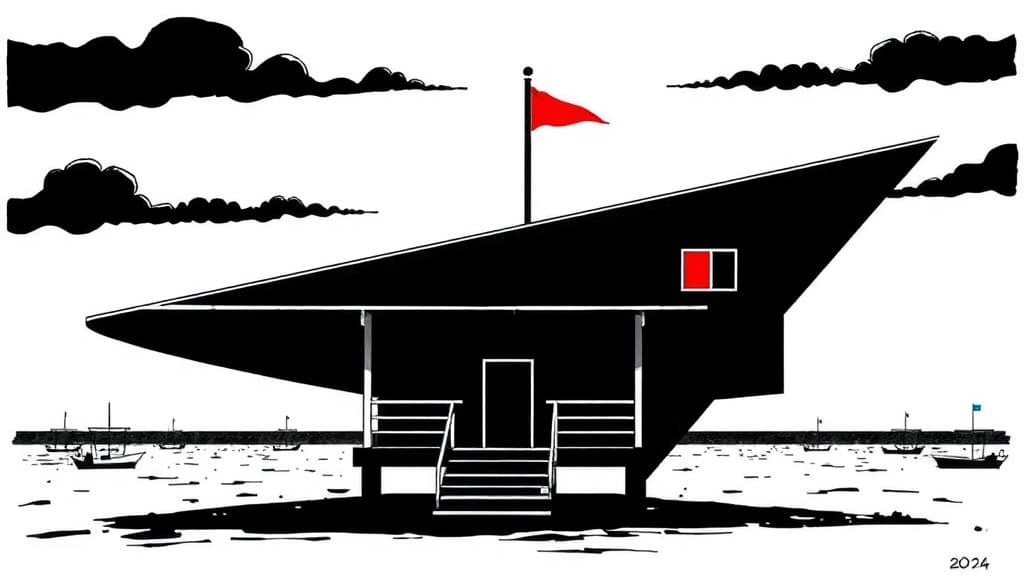
The last single-family home on Clearwater Beach's southern tip — held for sixty years against developer pressure — sold for $2.99 million last fall, and the buyer won't say what comes next.
For decades, two families refused to sell the Victorian-style cottage at 887 S Gulfview Blvd. as condo towers rose around it. The story of how they held out — and how the property finally changed hands — is a case study in what happens when concentrated capital meets an individual property owner in America: the money always gets another vote.
Built in 1963 by Carl Wilkens and Mary Ackert, the four-bedroom gray house with double-tiered terraces sat on a .3-acre lot a stone's throw from Clearwater Harbor. Two sets of homeowners spent over six decades turning down every buyout offer from condo developers hungry for the last undeveloped oceanfront slice in the area. Ackert earned the nickname "The Holdout Lady."
According to a dolphin-watch boat captain whose account was relayed by writer Cathy Salustri in 2021, the developers did not play clean. Construction workers "accidentally" cut her power lines. A bulldozer "accidentally" broke the water main supplying her drinking water. "And still, she stayed in her home, no matter how ugly the developer made things for her," Salustri recounted the captain saying.
Local lore holds that Ackert then changed the deed so the property could only ever be used as a single-family home — a move designed to lock in her victory from the grave.
The original owners finally sold in 1986, reportedly only under the condition that the buyers were locals who wouldn't flip it to developers. That held — until it didn't.
In September 2023, the Holdout House hit the market listed at just under $7 million. It sat. Multiple price cuts followed until JRP Property Group LLC scooped it up for $2.99 million in November 2025 — less than half the asking price — according to public records. The seller was listed as Breeze Property Group LLC.
JRP Property Group is registered to James R. Polacek, a real estate agent with Charles Rutenberg Realty in Clearwater. Reached by phone, Polacek told the New York Post: "I'm not the one you want to talk to. You'd want to talk to my business partner. If he's interested, he'll call you. I seriously doubt he will be, though."
Cara Ameer, a Coldwell Banker agent familiar with the property, was more forthcoming about what's likely next: "It is likely for redevelopment on some level, despite it being a treasured piece of history along Clearwater Beach. It could be turned into a larger oceanfront estate, condo building or hotel/resort or restaurant. I'm sure the property will be transformed into its highest and best use, despite locals likely not being in favor of that."
"Highest and best use" is real estate code for whatever makes the most money — community sentiment be damned.
The New York Post framed this as a curiosity — a "mystery" about the property's future. They buried the harassment allegations against developers deep in the piece and left the reported deed restriction unverified. The Santa Rosa Press Democrat, given this story, ran a bot-generated listing of a $2.34 million Napa house instead. Nobody with institutional backing bothered to ask the real question: if Ackert's deed restriction exists, is it enforceable — or just another speed bump for capital to roll over?
The price of progress, Ameer said, "makes it harder to preserve these properties that have so much legacy and history, unfortunately." That word — "unfortunately" — does a lot of work. It concedes the fight and moves on.
One woman held the line against developers who cut her power and broke her water. She put a deed restriction in place to protect the property after she was gone. Now a shell company owns it for $3 million, and the agent says redevelopment is likely. The only question left is whether Ackert's final legal safeguard holds — or whether concentrated wealth found another way around it.