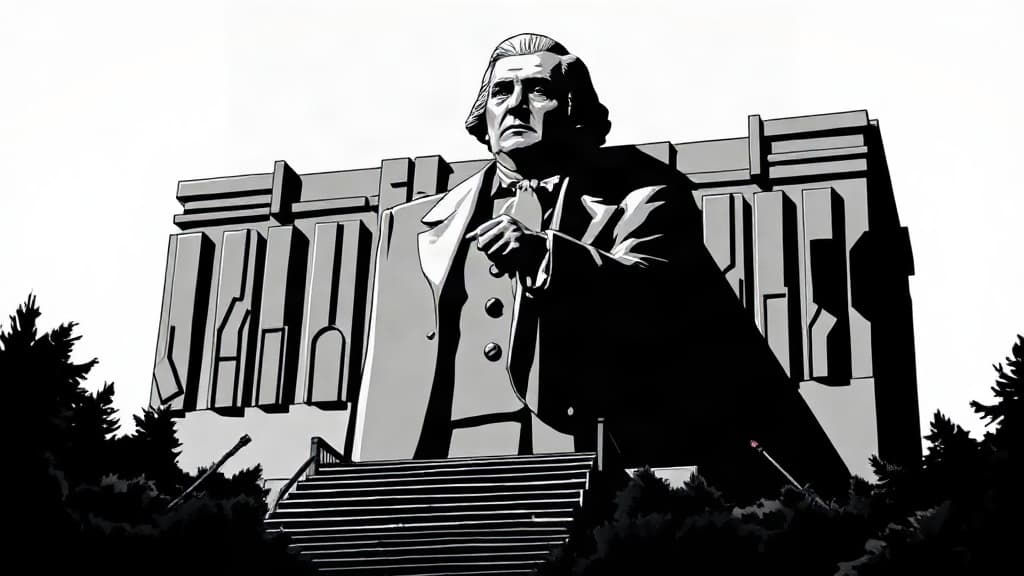
President Trump demanded the Smithsonian Institution install a 30-foot "Colossus statue" of George Washington outside the National Museum of American History and launch a special exhibit honoring the first president through the 300th anniversary of his birth in 2032 — a direct challenge to an institution that has spent years sidelining the Founders in favor of grievance narratives.
The stakes are straightforward: the Smithsonian is the nation's memory, funded by taxpayers, and right now it can't be bothered to mention Washington's crossing of the Delaware or his victory at Trenton. If the people who built this country aren't honored in its own capital, the museum isn't doing its job.
Trump posted the request on Truth Social while en route to his golf course in Ireland. "He is easily America's Greatest Hero. Without him, our Country and our Freedoms wouldn't exist," Trump wrote. He called the Delaware crossing "one of the greatest moments and turning points of the Revolution" and said those who "fought and died for our Independence, deserve far more attention."
The proposed Colossus would replace the current "Infinity" sculpture by New York artist José de Rivera, a federal commission installed in 1967 — abstract art standing where the nation's founder ought to.
Trump also wants an 11-foot Washington statue, recently featured at the Freedom 250 IndyCar race, placed in the museum's Flag Hall for Constitution Day on September 17.
The broader fight has been building. In March 2025, the administration released a 162-page report accusing the museum of fixating on oppression and social justice rather than shared national achievement. In July, Trump ordered the Interior Department to post signs outside the museum telling visitors the exhibits are inaccurate and should be renovated per the report's findings. Those signs have not gone up.
Trump has pushed to replace the museum's now-ended "Center for Restorative History" — an initiative spotlighting stories "excluded from the national historical narrative" — with a "Center for American Heroes."
The Guardian framed Trump's move as an expansion of presidential power, noting he "sees himself as curator-in-chief" and questioning whether he has the authority to order changes. The Smithsonian operates outside the executive branch, governed by a board of regents that includes Vice President JD Vance, Chief Justice John Roberts, and a bipartisan group of lawmakers and citizens.
What The Guardian buried: the actual content of Trump's complaint. A federally funded museum dedicated to American history that doesn't mention Washington's Delaware crossing or Trenton isn't a neutral institution — it's an institution that made a choice. The question of legal authority is real, but so is the question of why the Smithsonian needed a "Center for Restorative History" more than it needed a center for the people who founded the republic.
Smithsonian Secretary Lonnie Bunch, who announced last week he will step down by year's end after seven years leading the institution, told the Washington Post: "We're at a time when people are challenging that independence."
Independence from what, exactly? From the public that funds it? From the country whose name is on the building?
The pattern extends beyond the Smithsonian. The Kennedy Center board, now stacked with Trump appointees, recently removed "Blue," a sculpture by the late New York artist Joel Shapiro, with no public notice. Trump has also proposed a "Garden of Heroes" along the Potomac. The establishment press will call all of this authoritarian. The question they won't answer is why a museum called "American History" couldn't find room for George Washington in the first place.
The real fight isn't about a statue. It's about who gets to decide what America means — and whether the people who built it still own the story.