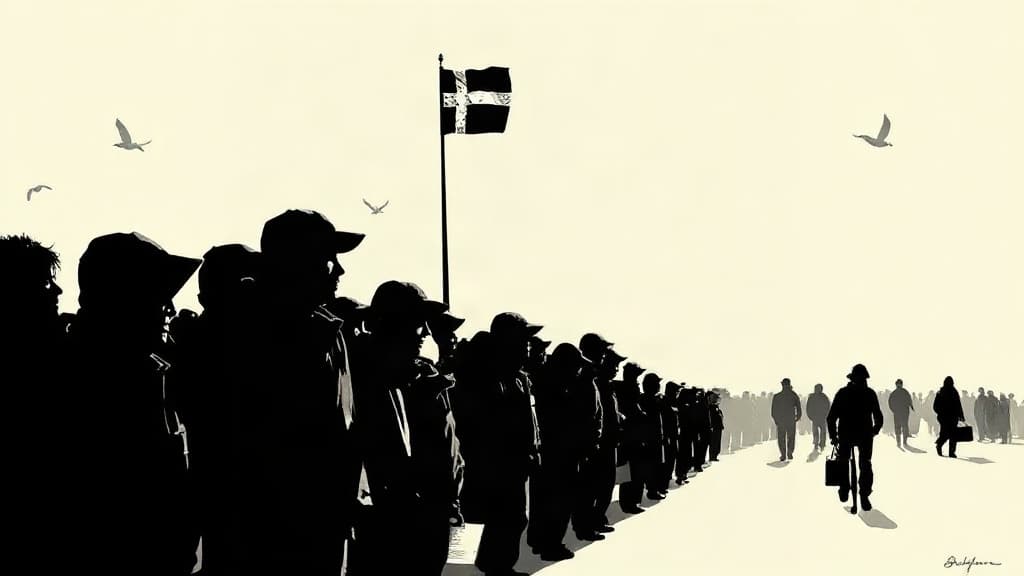
Swedes head to the polls Sunday in an election dominated by the fallout from mass immigration—gang violence, Islamist extremism, and a homicide rate that dwarfs the European average—and the results should be a flashing red signal for every American who thinks open borders come without cost.
Prime Minister Ulf Kristersson's center-right bloc trails slightly behind the center-left Social Democrats led by former PM Magdalena Andersson, but the real story is the Sweden Democrats. The anti-immigration party, once marginal, is now positioned to enter government and claim cabinet posts if Kristersson holds on. That's not a fringe event—it's a nation recalibrating after decades of elite failure.
Sweden took in over 160,000 asylum seekers in 2015 alone—12% of all who sought protection in the EU that year, according to Sweden's Migration Agency. That's the equivalent of America absorbing roughly 4 million newcomers in a single year. The political class called it humanitarian leadership. Ordinary Swedes got gang violence.
In 2022, the country witnessed 391 shootings resulting in 62 deaths, per the Swedish National Council for Crime Prevention. Sweden's homicide rate now sits at roughly four deaths per million inhabitants per year—more than double the European average of 1.6. The homicide rate has been climbing since 2013, driven primarily by gun violence. Foreign policy expert Daniel Schatz put it plainly to Fox News Digital: Sweden went from being described as a "humanitarian superpower" to a "humanitarian basket case."
Schatz noted that "years of gang violence, Islamist extremism, persistent unemployment and pressure on public services have intensified the debate over whether integration has kept pace with immigration." Discontent, he added, extends to both foreign-born and native-born residents. Shootings have declined recently, but as Schatz warned, fewer shootings don't mean the integration problems are solved.
The Sweden Democrats' rise is the political consequence. The Associated Press reports the party was founded by activists with ties to far-right extremist groups, including neo-Nazis. Under leader Jimmie Åkesson since 2005, the party toned down its rhetoric and expelled racist members. Whether that's genuine reform or rebranding, voters clearly don't care anymore—they want the immigration issue addressed, and the mainstream parties failed them.
Sweden's welfare state, once the envy of the West, has been restructured under economic strain from both left and right governments. The social benefits remain extensive, but rising crime and fiscal pressure have shattered the old consensus.
After 2015, Sweden started tightening borders. Kristersson's government accelerated that shift. Too late? That's what Swedes are voting on now.
The question for Americans isn't whether Sweden's situation is identical to ours—it isn't. The question is whether the same dynamics play out here on a larger scale. Mass immigration without assimilation, elite promises without accountability, and a political class that dismisses concerns until the ballot box forces their hand. Sweden's having that reckoning now. Ours is coming.