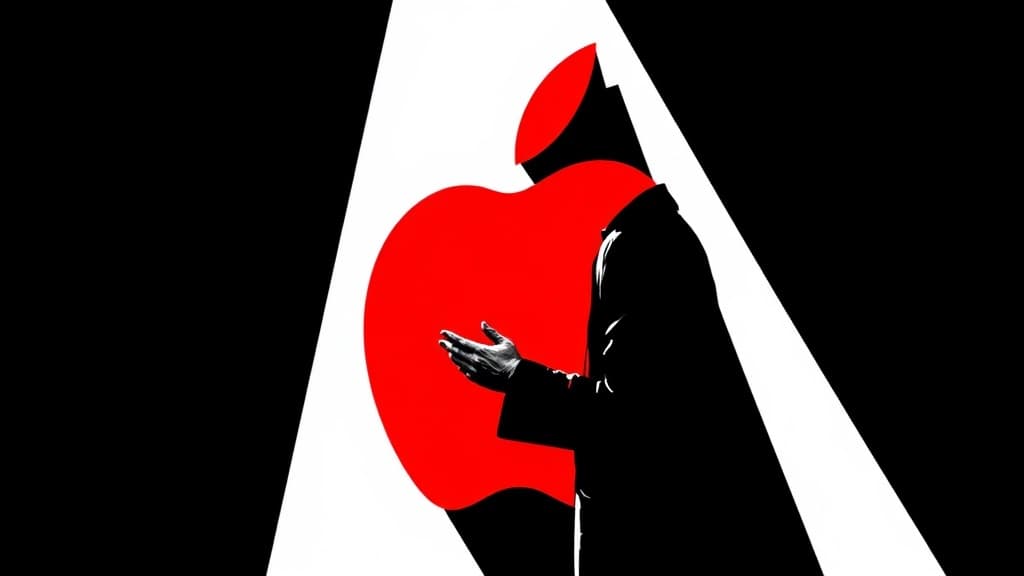
Tim Cook has anointed his successor at Apple — the company that decides what hundreds of millions of Americans can say, read, and share on their own devices — and the choice was made behind closed doors with zero public input.
John Ternus, Apple's Senior VP of Hardware Engineering, will take the CEO seat in September 2026, Barchart reported. No external search. No transparency. Just Cook's word that "there is no better person to take the helm of the company." When a $4.55 trillion corporation that runs the most restrictive app store on the planet — the gatekeeper controlling what software Americans are permitted to install on phones they bought and paid for — picks its next leader in a closed loop, that isn't a transition. It's a coronation.
Cook announced the hand-off on what he called his final earnings call, declaring the transition "going seamlessly" and praising Ternus as "truly one of a kind." Ternus, for his part, has said he considers himself "lucky to have worked under Steve Jobs," according to Apple's official announcement — a line designed to stitch the new boss into the company's founding myth.
What neither Cook nor Apple addressed: the fact that this company sits atop the most consequential censorship infrastructure in the Western world. Apple's App Store review process has repeatedly deplatformed apps and content on political grounds, from Parler to privacy tools to speech platforms that fell outside the approved ideological lane. The question of who controls that machinery is not just a shareholder concern — it's a constitutional one. But you won't hear that on an earnings call.
Investors, meanwhile, are jittery. Apple stock dropped 7% after the most recent earnings report despite strong headline numbers — $109.4 billion in revenue representing 16% year-over-year growth and iPhone revenue surging 22%. Morningstar trimmed its fair value estimate to $285 per share while the stock trades around $312, signaling modest overvaluation even after the selloff. The uncertainty isn't just about leadership; it's about whether Ternus can juggle supply constraints projected through 2027, an AI strategy lagging behind Google and Meta, mounting App Store regulatory pressure, and the delivery of Apple's first foldable phone on deadline.
Barchart framed the story entirely around shareholder risk and portfolio strategy — a narrow lens that treats the CEO of a speech-controlling monopoly as just another corporate executive. What went unmentioned in both the financial press and the company's own messaging is the power Ternus will inherit over the information environment. Top mutual funds have poured $13.97 billion into Apple recently, treating the transition as manageable. For the institutional class, the only question is execution. For Americans who depend on Apple devices to communicate, the question is who decides what they're allowed to say.
Cook's public statements have effectively set the guardrails for his successor — on pricing, on AI, on supply chain. What he didn't set guardrails on is the one thing that matters most to a free people: the speech policies that make Apple the most powerful private censor in the world. That silence is the tell.
Ternus will take the reins of a company that has never been held to account for its censorship regime. The only question now is whether he'll be any different — or whether he was picked precisely because he won't be.