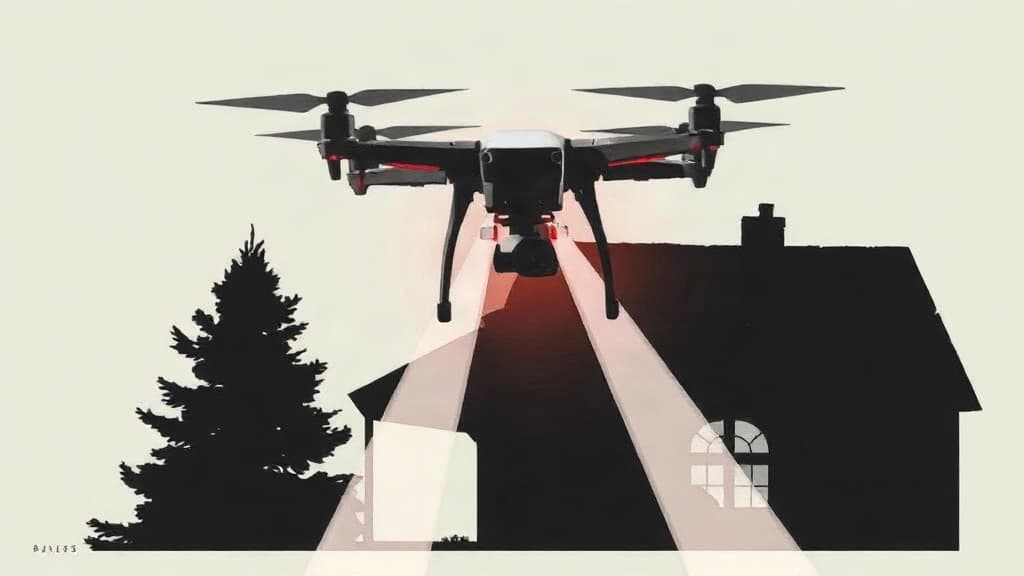
Police now fly surveillance drones into American homes as standard operating procedure, and the institutional press covers it like weather.
In San Antonio Monday, a 41-year-old woman was found shot to death inside her home after her husband allegedly murdered her. When SWAT couldn't reach anyone inside by phone or loudspeaker, they sent a drone into the house. The suspect grabbed it, smashed it to the ground, then walked outside and pointed a handgun at officers. Two SWAT officers shot him. He survived in critical but stable condition.
WJLA reported Police Chief Jesse Salame's account with no friction: "They sent a drone in, at which time they saw the suspect." No warrant mentioned. No discussion of whether flying a camera into a private home raises a Fourth Amendment question. It is simply what police do now. WJLA buried the drone deployment in paragraph nine, treating it as unremarkable as a flashlight.
The department didn't name the drone manufacturer. The outlet didn't ask. Nobody named the company that sold the equipment, the contract that paid for it, or the officials who approved the purchase. The surveillance state advances one routine deployment at a time, and nobody in the press corps thinks to ask who's getting paid for it.
Meanwhile, in Lexington County, South Carolina, a different kind of system failure was on display. A sheriff's deputy working security at a gun and knife show at Jamil Temple was shot and wounded November 14. The shooter, 34-year-old Telvin Pierre Portee, was killed by return fire. The Charleston Post and Courier reported that Portee's criminal record stretches back to 2010 — 61 entries under his name in Richland County courts, over 20 unique charges. Two separate attempted murder charges. Five unlawful pistol possession charges. Burglary. Kidnapping. Possession of a firearm by a convicted violent felon. Multiple court orders for mental health treatment. And yet Portee was walking a gun show on a November afternoon armed.
The Post and Courier noted it was "unclear from public records how much total time Portee spent in jail." A man charged with attempted murder twice, flagged for mental health treatment by the courts, convicted of violent felonies — and the system cannot account for why he was free. The paper also noted that camera footage of the shooting hasn't been released and that SLED is investigating.
Two stories, two failures moving in opposite directions. In Texas, the state's surveillance capacity expands into your living room without a whisper of constitutional debate. In South Carolina, the state's capacity to keep violent repeat offenders off the street has collapsed. The drone flies in; the felon walks out.
Who makes the drones your local police fly into your home? Which city council approved the contract? Which legislator wrote the statute permitting warrantless aerial entry into a private residence? Those questions go unasked because the outlets reporting these incidents treat the drone as a prop, not a policy — and the companies cashing the checks prefer it that way.