A man shot in the head, stuffed in a barrel, and dumped in Lake Mead went nameless for over 40 years — another reminder that while the federal surveillance state watches ordinary Americans, it can't deliver basic justice for the dead.
On Thursday, Clark County Coroner Melanie Rouse finally gave him his name back: Edward Lelburian Jackson, known to family as "Buddy." Born in 1930 in Arkansas, Jackson was in his mid-50s when someone executed him and hid his body in a rusted drum. His family never reported him missing. "They knew that he had traveled the country, would show up when he showed up, just to say hi," said Las Vegas homicide Lt. Robert Price. "But they didn't think anything other than that."
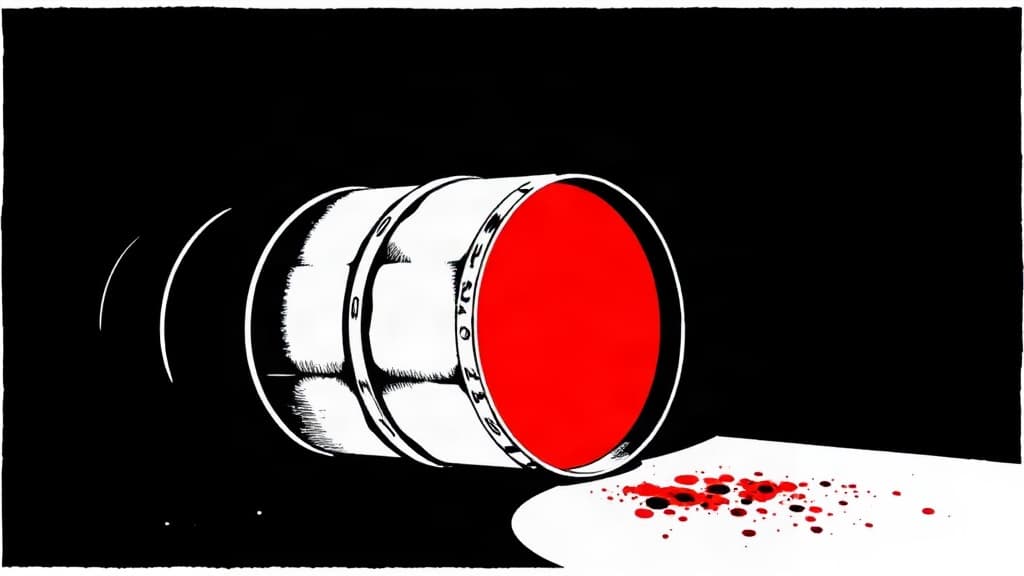
The barrel surfaced in May 2022 at Hemenway Harbor — exposed only because Lake Mead's water levels cratered after decades of overuse and drought. Boaters found him first. An autopsy confirmed a single gunshot to the head. The clothing — an Idle Time brand button-down, light-blue jeans, size 11 Trax sneakers, and a silver Timex on his wrist — placed the killing somewhere between the mid-1970s and early 1980s.
Jackson had a record. SFGATE reported that in 1982, he was paid to torch a mobile home and trailer in a fraudulent insurance scheme. He pleaded guilty to conspiracy in March 1983; the arson charge was dropped. He'd briefly lived in California, filing for a marriage license in Los Angeles County in 1953. But why he was in Vegas — or what he did for a living — remains a mystery. His family told detectives they had no idea.
The New York Post leaned hard into mob theories, noting that Las Vegas has an "expansive history of organized crime" and that a barrel dumping is "known to be indicative of a mob killing." The Mob Museum even speculated the victim could be George "Jay" Vandermark, a cheat gambler tied to the Stardust casino, or William Crespo, a drug runner turned federal informant, or Johnny Pappas, a casino insider with a boat on Lake Mead. All three vanished without a trace. The Guardian and SFGATE were more measured, noting that Price explicitly told reporters: "At this point of our investigation, we don't have any information to support those theories." Price added that police aren't ruling anything out.
The break came through investigative genetic genealogy — the same method used to catch Gilgo Beach killer Rex Heuermann and identify a second 9/11 World Trade Center victim this week, according to the Post. A forensics team at Oklahoma State University partnered with investigators and matched Jackson's DNA profile against a believed family member. The technology works. The question is why it took four decades and a drought to get there.
Lake Mead has been coughing up its dead ever since the water receded. The Guardian reported that a second, empty barrel was found days after Jackson's by a KLAS-TV news crew. Paddleboarders discovered remains on a newly exposed sand bar. In August, more human remains surfaced. County officials tied other 2022 finds to a 2002 drowning, a Las Vegas man who vanished in 1998, and a 1974 drowning accident. Historians predict more bodies will follow.
Price vowed the case stays open: "It will never be closed until we solve it." That's the right sentiment. But a man was shot dead and dropped in a lake, and for 40-odd years no agency — local, state, or federal — could even tell you his name. The technology to identify him existed for years before anyone bothered to use it. Jackson's family assumed he was just drifting. Law enforcement assumed the same. Nobody came looking.
The barrel came up because the water went down. That's not justice. That's luck.