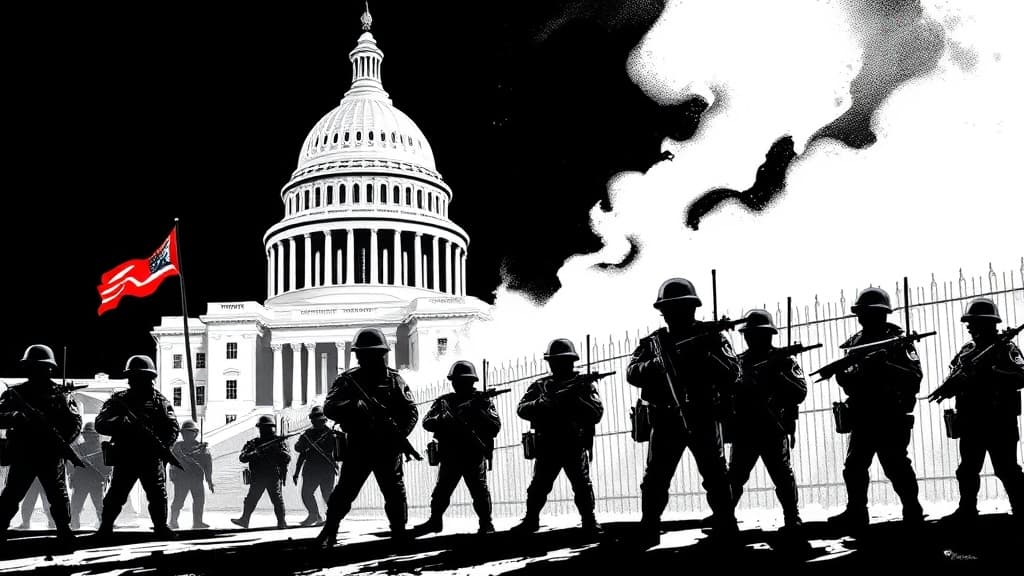
Nearly 5,000 National Guard troops now patrol Washington, D.C. — replanting grass, washing graffiti, and securing July 4 festivities — while American communities along the southern border face cartel operations, fentanyl, and mass crossings with nothing resembling this kind of federal force.
Defense Secretary Pete Hegseth on Thursday praised the Guard members as the "real" 1% and claimed they had reduced the city's crime rates by "staggering amounts." He appeared alongside White House Deputy Chief of Staff Stephen Miller at Meridian Hill Park to recognize the D.C. Safe and Beautiful Task Force.
The numbers tell a different story. According to Washington's police data, violent crime this year is about the same as at this time in 2025. Property crimes — burglary from cars, motor vehicle theft — are down about a quarter. When Trump deployed the Guard last August, the Boston Globe reported violent crime had already fallen to a 30-year low. Arkansas Online noted crime rates were near a six-year low at the time of deployment.
The deployment has ballooned from roughly 800 troops last August to nearly 5,000 today — equivalent to about eight Army battalions, according to the Globe. That is 30% more troops than General Douglas MacArthur commanded when he crushed the Bonus Army in 1932, and more than triple the Guard presence during the 1971 May Day anti-war protests.
Only 12% of those troops are D.C. National Guard members. The rest come from 24 states and territories — pulled from communities that may need them more than Washington's tourist corridors.
A National Guard representative said the troops have saved 235 lives, medically assisted 530 people, and returned 27 lost children to families since deployment. The ceremony included a moment of silence for Sarah Beckstrom, a 20-year-old Guard member shot and killed while on duty downtown in November.
Protesters organized by Free DC lined the park perimeter chanting "Guard go home!" Keya Chatterjee, a Free DC co-founder, said the armed presence looked like "stormtroopers" and called it a "visceral attack on democracy."
Hegseth welcomed the noise. "It's the sound of ingrates, of ingratitude, of people who are so blinded by ideology they can't see law and order and common sense in front of them," he said. "There's nothing ideological about this group. There's nothing political about this exercise."
The Globe framed the deployment as a "flex of federal power" over a city that lacks statehood. Arkansas Online noted Trump temporarily seized control of the city's police force. The D.C. attorney general's office tried to stop the deployment; a federal appeals court ruled in Trump's favor.
What neither outlet asked: if 5,000 troops can be mobilized to beautify Washington and secure a holiday parade, why can't equivalent force be brought to bear against the cartels moving fentanyl and people across the southern border? The Trump administration merged the National Guard, FBI, ATF, and D.C. police into a single task force for the capital. No such interagency surge has been deployed to stop the cartel invasion of American border communities.
The allocation of force is a statement of priorities. Washington gets battalions. Border towns get leftovers.